Damn these recurrent hiatuses. It happened again, as these things do. But we’re back this week — rather fittingly, after the long weekend — with a little look at crowdfunding in the beer business, some reminiscences over my marvellous trip to the Mussel Inn, and looking forward to the Great Kiwi Beer Festival this very weekend, at which I’ll be doing one of my little rambles. All that by way of bicycle bells and videogames, and accompanied by two rather strikingly different Beers Of The Week.
There are several sadly-long-neglected episodes in our proverbial back pocket, which I’ll upload over the coming weeks. You — our listeners and our excellent guests — have our apologies, and also our welcome back.
At Golding’s, where I work with1 Dylan of The Bottleneck blog, it’s not uncommon to see us indulging in a little game we call ‘Will It Shandy?’ when we’re trying out new arrivals to the taps. A shandy — that’s a beer mixed with lemonade, on the remote chance the word is unfamiliar to you — is a much-maligned thing, and this upsets us both greatly. They can be truly wonderful, in a few different ways and for a few different reasons. So, starting with the Platonic Ideal of the modern shandy — a simple pale lager and a mass-market lemonade — we sat down to try a few different types of beer and see what twists and nuances we could find; to investigate not just whether we thought something could shandy,2 but also to start to test the why. In the name of both Science and Silliness, we recorded our endeavours and you can listen to the result above — or indeed over at Dylan’s. Very many thanks to him for doing all the editing work, and to The Coconut Monkeyrocket for our theme music.3
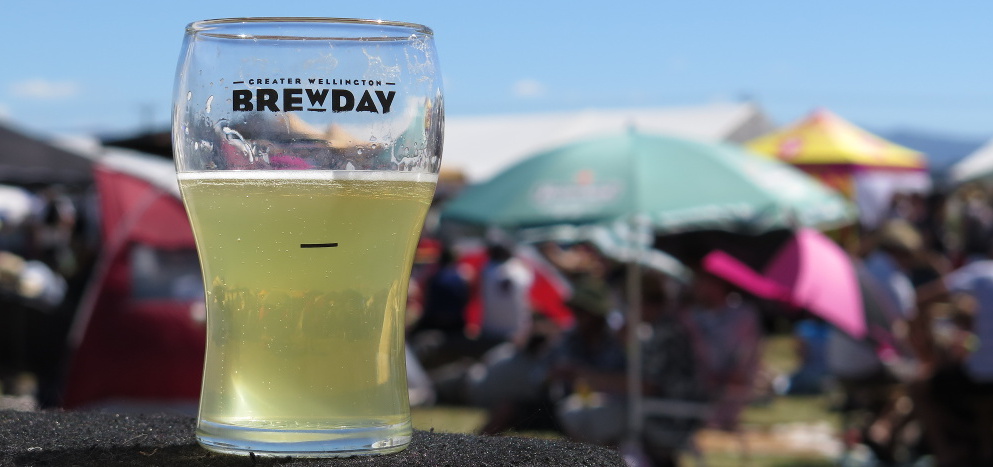
Wild & Woolly’s ‘Basilisk’ Berliner Weisse from Brewday 2015It’s a lovely day for a beer festival. Admittedly, I say this without bothering to look at the forecast or indeed out the window. Today is the fourth running of Brewday, a festival of wider Wellington’s beer and beer-adjacent communities, held over the hill in Martinborough — a place long thought of as wine country (and quite rightly) but also just generally the City’s sunnier back yard.4 I attended the previous three, and had an excellent time at each — in three very different capacities — but am sitting out this one on account of a looming shift in the bar this evening.5 But I have my own theory of making the most of Missing Out, and so this year I am enjoying the festival nostalgically.
The Wheatsheaf — one of the nicest pubs to which I’ve never been
A version of this post originally appeared in the Spring 2015 edition of SOBA’s quarterly magazine Pursuit of Hoppiness. The idea came to me during a guest spot on the Ale Of A Time podcast — though I didn’t realise at the time that I could just reuse and rework the standard acronym — and I was recently reminded of the point while Em was on holiday last week and managed to visit the Wheatsheaf (in Adelaide) before me and without me.
The Fear Of Missing Out is an ancient impulse made ever-sharper and more problematic by modern communications technology bringing news of happenings that are too far-flung or ill-timed, or both, to personally enjoy. It crops up often in the beer world, often rendered as “FOMO”6 — both for brevity’s sake and to encompass the wider emotions of anxiety, sadness, and jealousy that also so-naturally accompany missing out. But let’s recalibrate our f-word, so to speak.
The main mural, though other art and easter eggs aboundAn open door, at last
Way back in August 2011, the Beer Diary Podcast’s first ‘away mission’ took place in the then-fledgling Garage Project, er, garage. Yesterday, George and I were invited to record another at the ‘dress rehearsal’ test-run of their new bar just up (and over) the road — which opens today. As it turned out,7 I spent most of the four year stretch between episodes actually working at the brewery myself and though the idea for this place was locked in a while ago, I didn’t personally work on it and not much non-paperwork progress had been made before I left. So it was a real treat to drop in and see what they’d been up to on the eve of this, their latest Next Big Thing. The episode will be online soon8 and disclaimers ahoy, obviously, given my lengthy association with the company and the fact we were there on a special invite and drinking on their dime, but I just wanted to share a few photos and some brief first impressions — because the place is a) gorgeous and b) interesting.
So last week, Asahi bought Mountain Goat. And earlier this month Heineken bought half of Lagunitas, then the company which makes Budweiser acquired something called Golden Road, and just under three years prior to that Emerson’s was subsumed within Lion.9 Meanwhile: Russia re-annexed Crimea, Pixar has so far spent a decade in the belly of Disney, India smack-merged with the Eurasian Plate fifty-million-or-so years back and (geologically speaking) threw up the Himalayas, and in four billion years our galaxy will non-violently combine with Andromeda and send countless millions of worlds swirling into new orbits until something else supermassive comes along ― plus ça change plus c’est la même chose.
The weekend was the fifth anniversary of, well, this thing. It was Sunday10 the 26th of September, 2010, when I first hit the ‘Publish’ button on anything here. I’ve since done so three hundred and forty times,11 for an overall rate of one post every five or six days — which just shows you the nonsense you can bury under an average. In truth, my activity here has fluctuated wildly, as has what you might call the mandate or mission. The initial intent was for this to be simply a backed-up and searchable version of the original, which itself was born about five years earlier when I scribbled the first-ever entry and transmogrified a blank notebook into a Beer Diary.12 On finally filling those pages and starting in on my second volume, five years and twenty-three days ago, I wanted to scan and upload its predecessor for safekeeping — and on account of the fact that you can’t grep dead trees.
What started as ‘Afterthoughts’ to that project quickly took over,13 though the Diaries still exist, gathering notes and bearing witness to my primary impressions of a beer or festival or whatnot. The revised and broadened nature of, well, this thing slowly found an audience and even picked up an award. But with a shift in my “day job” (to an actual day job), productivity here waned; the switch in what energy was used up during the day and what was left to burn off saw my swimming and gardening increase and writing time decline.14 I’m still attempting to rebalance all that again, with mixed success.
But anyway, I was put in mind of all of this — i.e., these five years and the utterly marvellous and/or baffling beers and occurrences and best-of-all people that have been bound up therein — by (of all things) a spot of spring cleaning a few days ago. In the kitchen cupboards at home was an unexpected trove of bottles that spanned such a swathe of time that I idly wondered if it covered the entirety of this thing’s existence and so had to look up the dates. And lo, here we are. And yes, they do. The Beer Diary started its life15 as a memory aid. Fitting, then, that a steady accumulation of forgotten things would furnish an excuse to think back, try to remember how these nearly-three-dozen bottles came to comprise my stash — and ponder what to do with them. Because some beers really do age spectacularly gracefully and can sublimely cap off an occasion. Others, of course, do not. Time, then, for a census of my accidental cellar, to see what it says about the last few years.
I spent a few hours on Saturday in the beer-bunker that is Hashigo Zake, in the company of two-dozen-or-so like-minded folks and enjoying the Brewers Guild Awards beaming at us from Auckland over a mercifully-dependable livestream. It was a properly marvellous occasion,16 and the Guild (with new host, Hilary Barry) put on a great show. It’s truly heartening to see the gradual evolution of the industry, particularly the maturation of the “craft”17 corner thereof as it becomes less of a niche or subculture and settles into being just part of the landscape. But as if on cue, two abysmal videos surfaced late last week18 — both from TV3’s ‘Story’ program — to remind us how far we have to go in terms of generalised acceptance and understanding. If you can stand the cringe, I think they’re worth watching for how instructively shallow and terrible they are.
Apples, oranges, and a silly hat
The first is styled as a taste-off between craft beer and quote-unquote “normal beer”, with the former signified by hats, hipsters and IPA and the latter bluntly equated with lager. Through four rounds of anonymous beers from unidentified styles served in a misnamed bar (“Beer Brothers”), the contestants follow their tired generational stereotypes and spend a suprisingly long time saying not very much of substance. The comparisons, kept completely mysterious, don’t really illuminate anything: were the beers they put up against each other even trying to do similar things or was this pure apples-to-oranges time-wasting that forgot that everything is best in its right place and something calm and friendly isn’t automatically inferior to some-other-thing attention-grabbing and audacious? Who the hell knows?
Heineken and other nonsense
Weirder and worse, though, is the rambling chat with Scott McCashin.19 It puts the “taste-test” piece to shame in terms of its wordy emptiness, with bonus side orders of contradiction and claptrap. The website dutifully regurgitates McCashin’s nonsense claim to being New Zealand’s first craft brewery — a boast which rings hollow whatever your definition of that contentious term20 — and you could easily come away from listening to the piece knowing a lot less than you did going in. It’s an absolute mess: mainstream beers are all ‘thinner’ and brewed with ‘less ingredients’ and perhaps particularly ‘less hops’, seemingly across the board — and Heineken fills a strange duel role as the name-dropped example of something flavourless and disappointing and the hoppy interesting thing that started a revolution. Craft beer, he says, “doesn’t have sugar added” which will come as a huge shock to generations of Belgians and Brits and others — if you don’t understand that sugar isn’t an inherently evil ingredient and can be used to make certain types of beer more enjoyable (rather than merely for cost-cutting) then you need to stop “educating” the public immediately and maybe reconsider whether this is the right business for you. Scott’s sole good point about the wide appeal of craft beer is lost under a mountain of muck and the reporter does nothing to tease out any clarity or coherence, instead belaboring a weird analogy about religion and dragging out the old “extreme beer is for hipsters” trope. His late realisation that all this uncritical dreck amounts to a mere ad is depressingly tossed aside.
Both of these pieces should’ve been spiked. There’s just no there there, in either of them. They add precisely nothing, merely reinforcing old clichés and (worse) muddying the water. The latter, in particular, is hopefully an embarrassment to the producer, editor, reporter and subject alike. If the brewery are delighted with it, or the Brewers’ Guild and/or their PR firm have chalked these up as marketing wins,21 then excuse me while I despair. There is a lot of good stuff going on in the beer-related and beer-adjacent media.22 Some of it, to my delight, percolates into the mainstream and is presented to diverse new eyeballs. But we all need to do more, and do it better, to break through the stereotypes and misinformation and nonsense.
Last weekend, a small army of judges assembled in Christchurch to assess a considerably-larger army of entries in the annual round of the local Brewers’ Guild Awards.23 We won’t know the results until next weekend24 but ― SPOILER ALERT ― Tui will not win the trophy for New Zealand styles. I don’t say this because I have any form as a gambler or guesser of these things, nor because it doesn’t deserve to score highly in the peculiar context of how beers are judged against predefined styles. Instead, it’s ruled out of trophy contention thanks to a new rule ― well, new-ish; it seems it was enacted last year, but I didn’t notice,25 and didn’t see anyone else mention it, but I think it’s worthy of some attention and some applause.
Truth in trophy-giving
“A beer will not be eligible to win a trophy if the commercial name of the entry stylistically differs from the class it was entered in,” says the new26 rule. So Tui, a brown lager which fits squarely into the New Zealand Draught category despite being feverishly marketed as an “East India Pale Ale”27 can’t add to its small collection of silverware. Likewise there’ll be no more European Lager Styles trophies for the vienna lager which Speight’s dress up as “Distinction Ale”. And maybe there’s a case to be made that Boundary Road’s Haägen ― which wears a German flag and generally looks as if it’s trying to sneak into a bar using Beck’s driver’s licence as ID28 ― should see the end of its winning ways in the “New Zealand-style lager” category.
The general justification, anyhow, is solid: once you admit that the awards aren’t entirely an inwards-looking game that the industry just plays among itself, and instead you acknowledge that some non-zero fraction of the beer-buying public also gives a damn about them, then some kind of gatekeeping obligation kicks right in. It admittedly wouldn’t make the top million in a list of the world’s most-pressing problems, but beer producers have a longrunning habit of fudging the terminology around styles and processes when it suits them, and it really does get in the way of wider and deeper public knowledge which, in turn, presents an obstacle to more people more-easily finding more beers they’ll love. As people at the geekier end of the spectrum ― if not outright bending the needle on the nerd detector ― it’s all too natural for us to assume that “everyone” can see through the nonsense of some marketing departments, but spend a little while bartending or hosting tastings (as I, you know, do) and you’ll see how depressingly common assumptions like “yellow = lager, black = Guinness, anything in-between = ale” are, and how they get in the way of people’s tastes evolving ― in whatever direction and to whatever degree they feel like, of course. Misinformation is no good for nobody.
A lifetime ago, in beer years ― the Malthouse blackboard celebrating Tui’s 2009 trophy win (as a way to troll me for my birthday) plus several bonus cute little anachronisms
The tricky bit here is the two inevitable slippery slopes:29 1) how strictly to police this ― whether it really is just names and really is just outright contradictions that disqualify, or if implications as to styles in the wider presentation of a beer also counts (such as the label text, marketing bumf, and sales material ― where quite a few black lagers are gently implied to be, say, porters) ― but more-pressingly, 2) why just trophies, and not also medals and the mere participation in this process at all? The first question is of the kind that’s always hard to solve, but the second seems pretty plain; the same reasoning which now denies Tui its trophy should also hold back a medal.
And in fairness, this nonsense is perhaps starting to fade. Monteith’s “Winter Ale”, a frequently-award-winning doppelbock, is now actually marketed as a doppelbock. This, remember, from the same conglomerate that so consistently misrepresents Tui.30 These terms all mean something, and it’s not hard to imagine a future in which they might be more dependably informative ― which, again, would benefit just literally everyone. That the Brewers’ Guild has decided to more-carefully dole out the prestige of its trophies with this in mind is an excellent start.31 But only a start.