
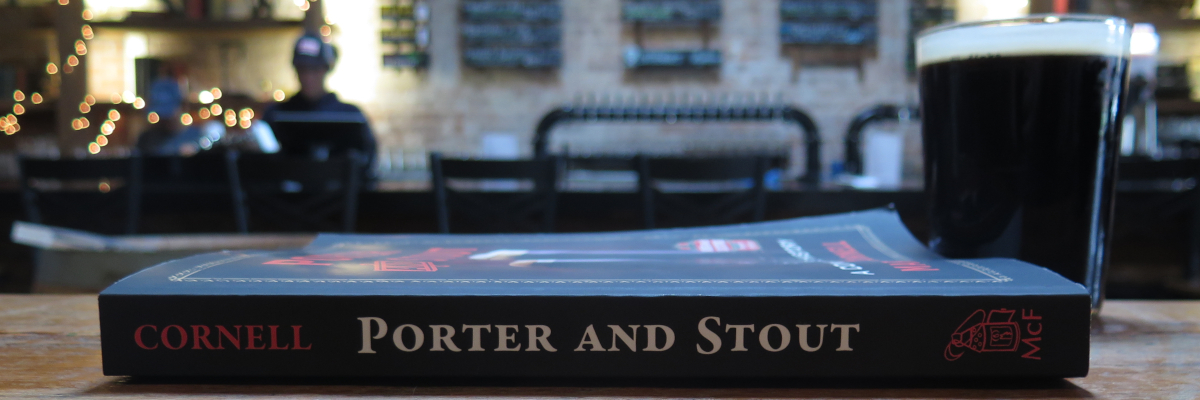
For a special edition of The Session, Boak & Bailey suggested that people take the time to respond to the work of the late Martyn Cornell, prompted by his final work, Porter and Stout. That convinced me to finally get a copy, and I did as I often do with sprawling reference books: I turned first to the section that deals with things close to (my) home on the far side of the world, to get an initial impression. Fair to say it’s an asset, an achievement, and perhaps surprisngly accessible. But it’s not the last word on its subject, nor should anyone wish it was.
It’s a formidable book at over four hundred large-format pages, nicely illustrated but mostly filled with dense two-column text, followed by forty pages of footnotes.1 This isn’t a pop history with scene-setting vignettes and quirky character portraits, but neither is it dry, tedious, or obscure; the relatively tight and clearly-titled sections are helpful to hold focus and maintain momentum, or enable a lighter browse.
Like a lot of people, I first encountered Martyn’s work in his ‘mythbusting’ mode and here it seems most of that has been collected into a few appendices. The longest is on ‘The Three-Threads Myth’2 concerning the origins of porter, and if you ever doubt the unending need for these things, a New Zealand brewery was passing along the old story (with a half-assed ‘maybe it’s folklore’ shrug) just a few weeks ago. Such nonsense takes a long time to eradicate.3 This structure keeps the debunkings in an easy-to-point-to place and prevents distractions about correcting misunderstandings from cluttering the actual history.
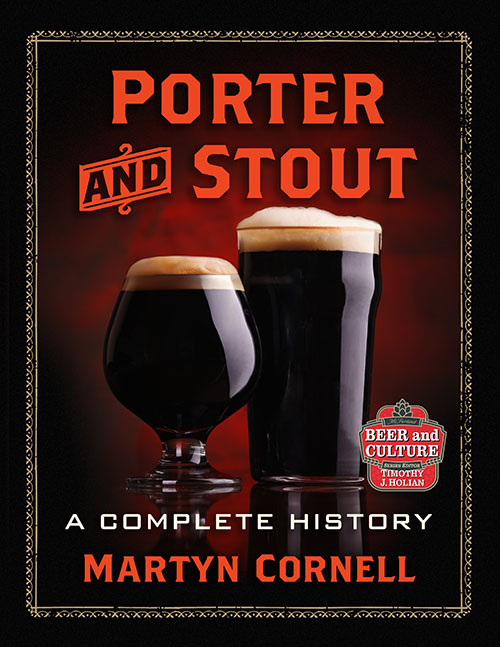
The cover pitches the book as “a complete history” and of course it can’t be — not in ‘just’ four hundred pages. That’s inevitable, not a failing. But when his very first sentence describes the project as telling “a 300-year story in three acts: rise to world conquest; long decline almost to vanishing; and sudden, triumphant rebirth and resurgence” it’s hard for me not to notice that New Zealand and Australia get short shrift indeed on that final third part of the story.
Chapter 47 is dedicated to Australasia, closing out a section describing porter’s dispersal around the world. Cornell describes its arrival with the English colonists in both countries, and early efforts to brew it locally rather than have this working-class favourite available only as a premium-priced import. Several still-familiar names like Tooheys and Tooth’s make early appearances.
In the context of increasingly vocal economic nationalism in Australia — as craft / indie breweries emphasise the “foreign-owned” nature of their large multinational competitors over every other difference4 — it’s amusing for me to see him describe early newspapers “berat[ing] colonists for failing to support local brewers” and quote an 1829 editorial “declaring that ‘Colonists cannot better display their amor patriae’ than by buying locally brewed beer rather than ‘sending so much of ‘the best of Capital’ out of the Colony for Porter, etc.’” That thread apparently runs deep in the national psyche.
In the more-recent past, from the mid-1900s or so, the narrative shifts to largely focus on Guinness, both as an import and something brewed locally under license — seeming lurch between breweries as contracts expired, success varied, and strategy changed. The citations also conspicuously shift from primary sources to secondary ones as if his attention is being dragged away,5 and each thread peters out; Australia gets two small notes about the 1990s and 2010s, NZ’s section closes in the 1970s.

The main ‘resurgence’ treatment, that “third act” foreshadowed in the introduction, is Part Ten of the book. Chapter 56 (‘The Return’) begins with Anchor Porter and chapter 57 (‘Pushing the Envelope’) continues the story into modern “craft” reviving various substyles and evolving new ones.6 Every brewery, every beer, every example of a trend considered worthy of a mention, is American or British.
Which is a shame, and particularly striking as I’d just read the account (chapter 55, ‘Other Odd Ingredients’) of oyster stout’s 1938 invention in New Zealand. That section had confirmed the general truth of something I’d already heard, while correcting errors (both big and small) I’d read in previous tellings from less-careful writers; an ideal experience with a book like this. But more to the present point, there’s a famous and beloved oyster stout in current production back home, and it has inspired several others. A small thing, sure. But it feels deserving of a brief “and they’re back at it, too” note — for completeness, since that was the goal.
It’s like how the New Zealand section of the ‘Australasia’ chapter closes by noting that local Guinness production ended in 1977, without ever returning to point out that it came back. It’s currently brewed (by Lion) in Auckland, and the fact it was previously produced in Christchurch was newsworthy after the devastating 2011 earthquake; I recall it being moderately controversial that the company got special permission to enter the cordoned-off part of the city to extract kegs in time for Saint Patrick’s Day distribution.7

And porter specifically played a surprisingly pivotal role at two key moments in the history of New Zealand beer during those decades after this book turns its gaze away. When Richard Emerson arguably started the country’s first “craft” brewery in the early 1990s his first beer was a London Porter, a decision that surprised many but seems to have paid off, as Michael Donaldson recounts in his biography of the man and his namesake company. Later, in the early stages of the pre-pandemic boomtime when contract brewing was such a core part of the local industry, one of the most influential operations, Yeastie Boys, also launched with a porter. Neither story is lost, obviously (indeed, one of them takes up a good chunk of a book) but their omission made me curious what other absences seemed similarly obvious to other readers from different contexts.
I have no idea if Martyn sought input from local writers beyond the authors he cited directly.8 But the gaps they might’ve filled — and anyway there were always going to be gaps — are a nice reminder that the rest of us have work to do in continuing to document the industry and the subculture as best we can. He already did much more than his fair share of the heavy lifting.
- Totalling 4,961 citations, by my quick count.
- Which seems to be (but oddly isn’t explicitly described as) an expanded edition of an article of his in Brewery History — a few sequences of citations are identical — and presumably incorporating material on the theme from his blog and fresh research.
- Always remember Brandolini’s Law: The amount of energy needed to refute bullshit is an order of magnitude bigger than that needed to produce it.
- This was a theme in some recent post-awards reaction, and I addressed it more directly last year.
- I’m not as familiar with the Australian histories cited, but one of the main New Zealand sources is Gordon McLaughlin’s The Story of Beer (1994) which is… not great. It was published by Lion (incidentally Guinness’ local contract-ee) and bears some bias in that direction, but more importantly lacks any primary citations of its own. The other, Rod Smith’s Guinness Down Under (2018), is even more heavily relied on but seems fairly idiosyncratic; a family narrative “woven through” with fictional correspondence. I hadn’t heard of it and haven’t yet had a chance to check it out; I’ll do so and report back.
- Its final line — just after mentioning the coining of “Pastry Stout” — is “What a London street porter in the time of George I would have thought, we can only try to imagine.” And that would’ve made for an excellent end to the entire book. But in one of a few weird structural choices, an incongruous section about brewing technology (mostly from the 1800s) takes that honour rather than being folded in earlier.
- Either the internet is harder to search for these things than it was, or my skills have atrophied (likely both) but I was at least able to find a scrap of a tangential citation for the extraction, if not the controversy.
- Boak & Bailey, in their own piece for this Session, noted that he had asked them about a detail of their local history, but I felt like reaching out myself to people Cornell might have / should have contacted in NZ or Australia would turn this into a muck-racking exercise, which isn’t what I’m going for.