

This weekend, the earthly remains of Rogue Ales (1988-2025) will be auctioned off, having been divvied up into nearly a thousand occasionally baffling lots. Like a few other breweries,1 my experience of them took a winding path: initial excitement as a much-hyped treat from afar, before fading into the background, then causing cringe as their shtick staled before a decline that, in hindsight, felt inevitable. Others have discussed the cause of death; it’s the treatment of the corpse that interests me today.
As ever, the most acute tragedy of these situations2 is the way the consequences fall so unevenly: staff thrown from stability into precarity, communities left without an amenity, and small-business suppliers shafted — all while the people who drove the company into the ditch enjoy limited liability and whatever buffer they’ve built from their fatter share of prior profits.
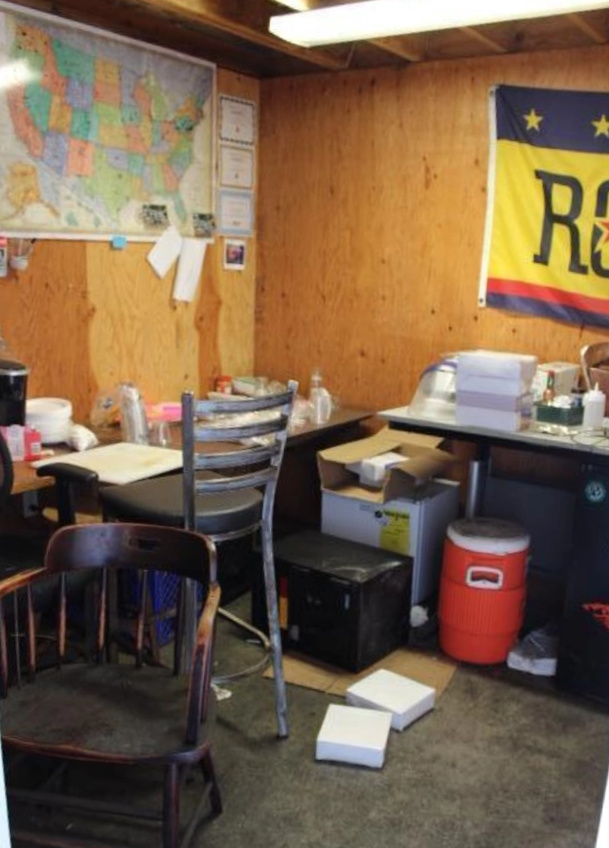
But there’s also a real indignity, somehow, in the way the once-proud company’s chattels have been catalogued. The suddenness of the closure was shocking at the time, and it feels reflected in the blurry and rushed-looking photographs of work spaces that appear hastily abandoned as if in an emergency, or at least the minor chaos of people who assume they’ll be back in the morning. This isn’t meant as a targeted criticism of these specific auctioneers; I’m struck instead by the system and set of incentives that lead to such an ignoble end.
The listings follow a vaguely logical progression through their facility in Newport. Starting in the brewhouse, with tanks ranging from moderate to massive to mysterious,3 plus plenty of “assorted hose”, a corner of miscellany, and half-full grain silos outside. We then go back indoors, through offices and hospitality spaces, before heading backstage again via the lab, past even bigger tanks, the bottling and canning lines, and on into the warehouse. After carefully passing the ominously-named pallet of “assorted fluids”, we find stacks of ingredients and other inputs, including nearly 3,000 cartons of hops, hundreds of barrels,4 and seemingly endless piles of pallets of flat-packed cardboard boxes ready for beer that will now never be made.
So when I saw lot #207 — a mash paddle — among items more at home in a tasting room than a brewery (i.e., tables and chairs, glassware), that gave me a little pause. And sure enough, it turned out to be something of a relic from their first decade, emblazoned with a plaque and mounted on the wall. Looking more closely at nearby listings, I found two World Beer Cup awards lurking anonymously among “assorted pictures” leaning against a wall. There’s history here — and I’m sure more is buried in boxes or hiding in messy corners, unobvious in the depths of the catalogue.5
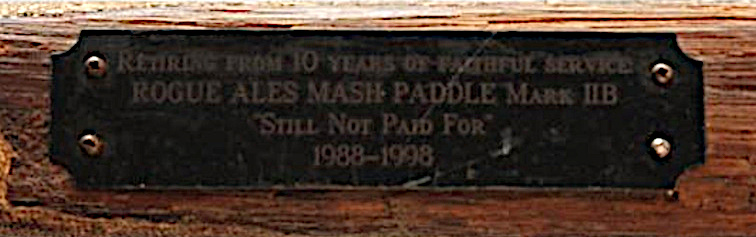
I don’t know enough about Rogue, specifically, to have a good sense of what ‘should’ be saved — or indeed how much, if anything, has already been done to preserve some of it. (I’m interested to hear, if you have information.) But the general question of this subculture’s recent-but-disappearing history has been on my mind lately,6 and seeing this auction was a visceral reminder.7
A brewery that keeps an eye on its legacy and puts a little work into the future of its history can be mindful about what goes where; if you wind up in liquidation, this happens. Maybe that mash paddle will end up down the road from me here in D.C., at the Smithsonian. More likely, it goes into a fan’s private collection — perhaps to one day confuse the administrator of their estate. Meanwhile, I’ve been trying for years to track down an (extremely famous) scrap of lost history from a different moved-then-merged American brewery; I’ll have to write that up, as a call for help.
And even if the cultural heritage aspect doesn’t move you, this feels like an insanely inefficient and wasteful way to wrap up a company. Back in Melbourne in 2024, when Deeds Brewing died, it had a kind of managed afterlife for a while, to sell through stock — including packaging out some barrel-aged beer in progress. That process wasn’t without its own issues, but it seemed like a promising model for smoothing the end, with obvious potential benefits to staff and suppliers, as well as giving people a decent chance to consider what remains as artifacts, not just assets.

Finally, since my Beer Diary started its life as a memory aid, and developed into its own little personal history, I looked over the half-dozen entries that featured Rogue. The first and last make for fairly fitting bookends.
In August 2009, my introduction to them was also my also inaugural visit to Hashigo Zake, the underground beer bar back home in Wellington which did so much for the local “craft” scene, connecting it with interesting overseas imports while also incubating homegrown startups.8 ‘Hashi’ itself closed in 2024, and I remember wishing I’d been able to pick up a few mementos myself when they offered up various relics from their walls for sale in their final days.
Then, ten years and one week after that first encounter, on a pre-pandemic trip to Portland, I visited their Eastside Pub & Pilot Brewery. By that stage, the shine had worn off them and that raised-fist revolutionary aesthetic sat uncomfortably with stories of their internal culture. I still had a good time there, but I recall being much more excited to visit Cascade (also now dead) and Modern Times (somewhat reanimated after basically dying, themselves). In the six years between that and buying the Dead Guy in the header image on this post, my notes tell me I hadn’t had a single other bottle, can, or pint of Rogue beer. Requiescat, and all that.
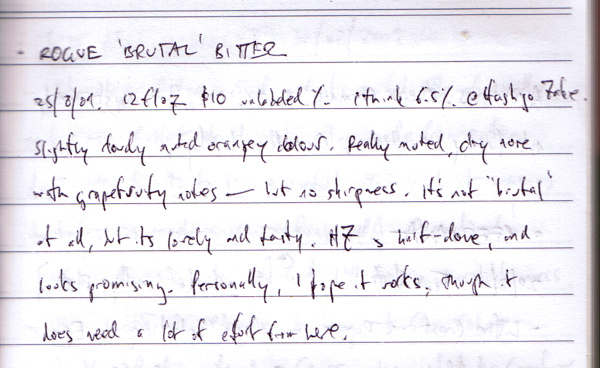 Beer Diary I, entry 159: Rogue ‘Brutal’ Bitter — 25/08/09 12floz $10 unlabeled% I think 6.5% @ Hashigo Zake. Slightly cloudy muted orangey colour. Really muted, dry nose with grapefruity notes — but no sharpness. It’s not “brutal” at all, but it’s lovely and tasty. HZ is half-done, and looks promising. Personally, I hope it works; though it does need a lot of effort from here.
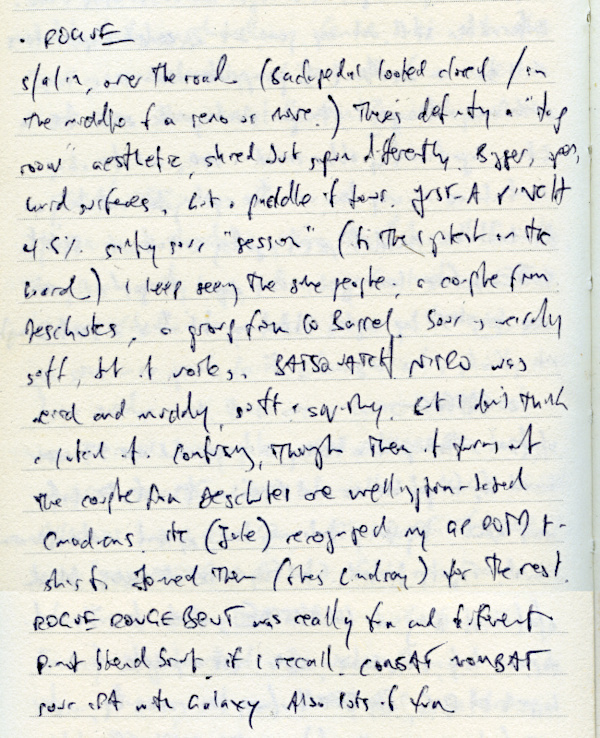 Beer Diary III, entry 152: Rogue — 5/9/19, over the road (Backpedal looked closed / in the middle of a reno or move.) There’s definitely a “tap room” aesthetic, shared but spun differently. Bigger, open, hard surfaces. Got a paddle of four. JUST A PINCH 4.5% salty sour “session” (it’s the lightest on the board) I keep seeing the same people; a couple from Deschutes, a group from 10 Barrel. Sour is weirdly soft, but it works. BATSQUATCH NITRO was weird and muddy, soft and squishy. But I don’t think I hated it. Confusing, though. Then it turns out the couple from Deschutes are Wellington-based Canadians. He (Jake) recognised my GP DOTD t-shirt. Joined them (she’s Lindsay) for the rest. ROGUE ROUGE BRUT was really fun and different. Pinot blend brut, if I recall. COMBAT WOMBAT sour IPA with Galaxy. Also lots of fun.
- See also, e.g.: BrewDog.
- See also, again: BrewDog.
- As Jeff Alworth noticed the other day, a lot of the hardware hasn’t attracted any bids and is sitting at the default minimum of $10. Bargain! But it’s worth noting that each piece has a fixed “rigging cost” (often running to several thousand dollars) to uninstall it and put it on your truck — and you do have a truck handy nearby, right..?
- I checked with the auctioneers and apparently they’re all empty. I was curious, since the grain silos are being readied for sale with their contents, and some lots of barrels had attracted higher bids for no otherwise-obvious reasons, but I’m told all the unfinished beer was “disposed of” — presumably there are tax and licensing concerns avoided by just dumping it all.
- I’d be curious to know the backstory of the handwritten sign mounted alongside lists of their awards, for one. It’s got some of that ‘Bartlet for America’ slogan-on-a-cocktail-napkin from The West Wing vibe.
- Not just with physical breweries, either; the death of Martyn Cornell last year and the way his blog subsequently went dark was a stark reminder about digital history. Luckily, the Wayback Machine has preserved a lot it, maybe all. But it’s clunky and link rot is still an insidious thing. I’ve found a potentially useful plugin for those of us on WordPress, but need a Tech Support day to get it working.
- My mind wasn’t completely stuck in bleak territory, I should say. It also gave me this listing of actual lots up for sale:
12 pallets clear glass bottles
11 high top chairs
10 custom display racks
9 boxes of body boards
8 assorted tables
7 assorted aseptic purees
6 assorted crab pots
5 WO-OD BARRELS
4 boxes of plastic cups
3 life rings
2 pallet jacks
and a Rogue neon sign (works intermittently). - Most notably Parrotdog and Garage Project — both of whom I worked for, in addition to working at Hashigo myself for a while.